
There is no single career that is perfect for everyone. The right career depends on your interests, abilities, education, personal goals, and the opportunities available in the job market.
For young people in Timor-Leste, understanding different career options and preparing early can make the process of choosing a professional path much easier.
Start by Understanding Yourself
The first step in choosing a career is understanding your own interests and strengths.
Ask yourself some important questions:
-
What subjects do I enjoy studying?
-
What activities do I enjoy doing?
-
What am I naturally good at?
-
Do I prefer working with people, technology, numbers, or physical activities?
-
Do I enjoy solving problems?
-
Do I like working outdoors or in an office?
-
Do I prefer working independently or as part of a team?
For example, someone who enjoys mathematics and working with numbers may be interested in accounting, finance, economics, or data-related careers. Someone who enjoys helping others might consider education, healthcare, social services, or community development.
Your interests can change over time, so you do not need to have everything figured out immediately. The important thing is to start exploring.
Learn About Different Career Areas
Before choosing a profession, take time to understand what different careers actually involve.
Some areas that may offer opportunities in Timor-Leste and internationally include:
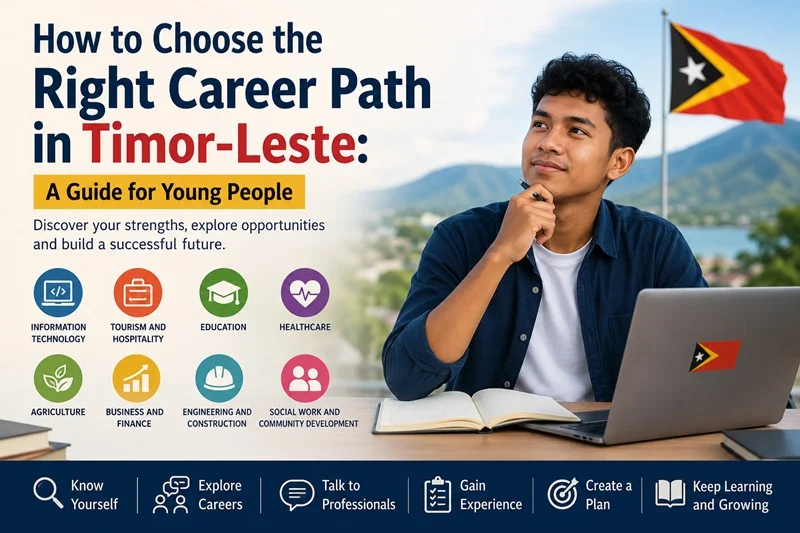
Information Technology
Technology is becoming increasingly important in almost every industry. Careers in IT can include software development, cybersecurity, computer support, networking, data analysis, and digital services.
Young people interested in technology can begin by learning basic computer skills and gradually explore more advanced areas.
Tourism and Hospitality
Timor-Leste has opportunities related to tourism, hotels, restaurants, travel, and cultural experiences. Careers in this sector can include hotel management, tourism administration, hospitality, tour operations, and customer service.
Foreign language skills can be especially valuable in this field.
Education
Teachers and education professionals play an important role in developing the country's future. People interested in teaching, training, and working with young people may find education a rewarding career path.
Healthcare
Healthcare is another important professional area. Depending on their education and qualifications, young people can explore careers in nursing, medicine, laboratory work, pharmacy, public health, and healthcare administration.
Agriculture
Agriculture remains an important part of the economy and can offer opportunities beyond traditional farming. Young professionals can explore agricultural technology, agribusiness, food production, agricultural management, and sustainable farming.
Business and Finance
Accounting, banking, finance, business administration, and entrepreneurship are possible career paths for people interested in managing organizations, money, and business operations.
Engineering and Construction
As infrastructure and development continue to be important, engineering and construction-related skills can be valuable. Possible areas include civil engineering, electrical engineering, mechanical engineering, architecture, and construction management.
Think About the Future of Your Industry
When choosing a career, do not only think about what is popular today. Consider how the industry may change over the next five or ten years.
Technology, artificial intelligence, renewable energy, digital communication, and environmental sustainability are changing the way many industries operate.
This does not mean that everyone needs to become a programmer. Instead, young people should think about how technology will affect their chosen profession.
For example, someone interested in agriculture could learn about modern agricultural technology. Someone interested in tourism could develop digital marketing skills. A person studying finance could learn how to use financial software and data analysis tools.
Combining a traditional profession with modern digital skills can make a candidate more competitive.
Talk to People Who Already Work in the Field
One of the best ways to understand a career is to speak with someone who already works in that profession.
Ask them:
-
What does a typical workday look like?
-
What education is required?
-
What skills are most important?
-
What challenges do they face?
-
What do they enjoy about their work?
-
What advice would they give to someone starting today?
Real-world conversations can provide information that you may not find in textbooks or online searches.
If you are interested in becoming an accountant, for example, try speaking with an accountant. If you are interested in tourism, talk to someone working in a hotel or tourism organization.
Learning directly from professionals can help you decide whether a career matches your expectations.
Gain Experience Before Making a Final Decision
You do not always need to choose your career based only on theory. Experience can help you make better decisions.
Consider participating in:
-
Internships.
-
Volunteer activities.
-
Student organizations.
-
Community projects.
-
Short-term training.
-
Part-time work.
-
Professional events.
Even volunteer experience can teach you valuable lessons about your interests and abilities.
You may discover that you enjoy a particular type of work—or that you do not enjoy it at all. Both experiences are useful because they help you understand yourself better.
Do Not Choose a Career Only Because of Salary
Salary is an important factor when choosing a career, but it should not be the only consideration.
A job that pays well may not necessarily be a good fit for your personality, interests, or long-term goals.
Think about the complete picture:
-
Income potential.
-
Job stability.
-
Opportunities for professional growth.
-
Working environment.
-
Required education.
-
Work-life balance.
-
Personal interests.
-
Contribution to society.
A successful career is usually one that combines your abilities and interests with realistic professional opportunities.
Create a Personal Career Plan
Once you have identified a career that interests you, create a simple plan.
For example:
Career goal: Work in Information Technology.
Step 1: Complete relevant education or training.
Step 2: Improve English and computer skills.
Step 3: Learn basic programming or IT support.
Step 4: Complete practical projects.
Step 5: Build a portfolio.
Step 6: Look for internships or entry-level opportunities.
Step 7: Continue learning new technologies.
Your plan does not have to be perfect. You can change it as you gain new knowledge and experience.
Remember That Careers Can Change
Choosing a career does not mean you must stay in the same profession for the rest of your life.
Many professionals change careers, learn new skills, or move into different industries.
A person who starts in administration may later move into human resources. Someone who studies agriculture may eventually work in agribusiness. A teacher may become a trainer or education manager.
The most important thing is to develop transferable skills such as communication, teamwork, problem-solving, digital literacy, and adaptability.
These skills can be useful in many different careers.
Final Thoughts
Choosing the right career path takes time, research, and self-awareness. Young people in Timor-Leste have many possible directions, from technology and tourism to education, healthcare, agriculture, finance, engineering, and entrepreneurship.
The best approach is not to choose a career simply because it is popular or because someone else tells you to. Instead, explore your interests, understand your strengths, research the job market, talk to experienced professionals, and gain practical experience whenever possible.
Your career journey may not follow a straight line. That is completely normal.
What matters most is to keep learning, remain open to new opportunities, and develop skills that can help you adapt to a changing professional world.
The career you choose today is only the beginning of your journey. With curiosity, preparation, and continuous learning, you can build a professional future that matches both your personal goals and the opportunities available in Timor-Leste and beyond.